Bang! You're Dead - Gun Violence and the Colonial Inversion
Recently I've had a newfound interest in video media from the 40s-50s with HBO Max's catalogue of Hitchcock, Franju and Curtiz films. There's something special about the aesthetic of highly stylized fashion, rural Americana and hazy diner lights that's unique to the time period.
I ventured a bit out, and with the recommendation from a friend, discovered the Hitchcock's Presents television show. Of course when viewing a series with countless episodes I wanted to watch the crème de la crème first, so I found a curated list of highly rated episodes. One of those being "Bang! You're Dead".
What initially appears to be a simple cautionary tale about gun safety gradually reveals itself as a quiet inversion of colonial assumptions about civilization and violence.
I urge you to please watch this episode before reading anymore of this blog post. You don't have to, but the text below takes away from the experience of watching it yourself. I watched it for free on the Roku channel.
THE BREAKDOWN
The plot of the episode centers around a 5 year old boy named Jackie who's excluded from a child's game of War because his toy gun looks 'cheesy'. Suddenly Jackie's father and his Uncle Rick pull into the driveway to greet him; telling him that Uncle Rick had just returned from a business trip as an automobile salesman to Africa. Uncle Rick presents to him an African tribal witch doctor mask as one of the few souvenirs he acquired in his stay, mentioning the mask was "the only thing left, just one incident. You could say it had its bloodbath.".
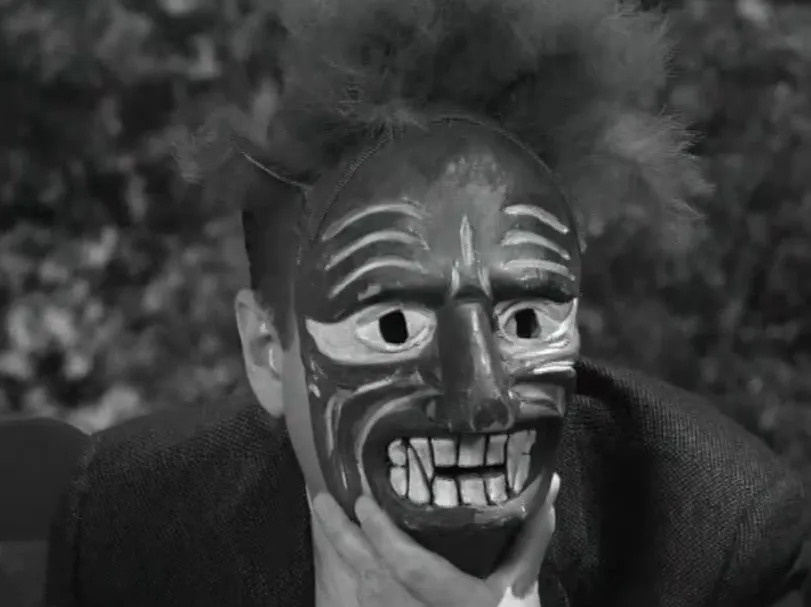
While the adults chat, it's established that Jackie loves to quick draw his revolver and fire off a few rounds excitedly at the mention of guns or violence. It becomes a common occurrence throughout the episode to spot children in cowboy outfits, holsters and toy revolvers firing at one another, seemingly inspired by the tales their parent's enjoy on the television inspired from the wild west of the late 1800's.
While unpacking his things, Uncle Rick tells Jackie that he has a special surprise gift for him that he'll hand over after the family party. Jackie's father pulls Uncle Rick away and asks Jackie to put his belongings away in the dresser. As Jackie pulls away socks and a jacket, he finds Uncle Rick's genuine .38 Revolver with a box of ammunition. We can assume Jackie believes the revolver to be the surprise gift as he puts away several bullets into his pocket, loads the revolver with a single bullet and walks out the door thanking Uncle Rick ahead of time for the gift.
At this point, the suspense has ramped up with the development of Jackie spinning the cylinder, casually pulling the trigger and clicking the hammer at his family members before he leaves. Jackie unknowingly is playing Russian Roulette with every figure he points and fires at and the stakes only get higher as he wanders off freely into town, playfully shaking down each person he meets.
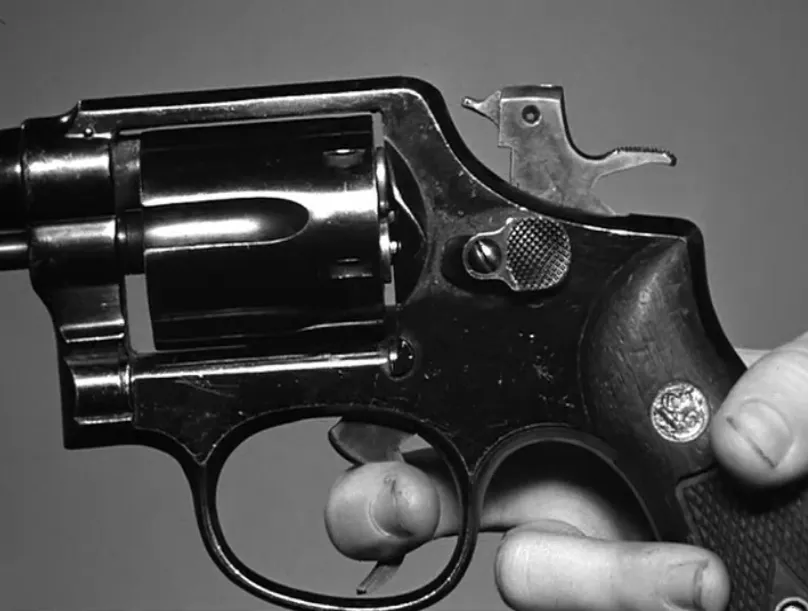
After Jackie's run in with a mail man, Uncle Rick feels the gun from his holster is a tad bit lighter than it's usual grip, along with finding an empty box of .38 ammunition. The realization has finally hit them as they race to go find Jackie before he accidentally shoots someone.
One of the more nail biting scenes is when Jackie arrives at the supermarket and drops a couple of bullets from his pocket while reaching for a coin to operate the mechanical horse. He loads another bullet into the chamber, and you see several instances of him firing at customers while the chamber rolls and the bullets get closer and closer to the barrel. A father and his daughter approach him as the little girl whines to ride the horse. The father bribes him to let her ride and when he won't accept any offers, he picks him up and pulls him from the ride. Jackie innocently threatens him as a 'horse thief' and slowly pulls the trigger, before spinning the barrel and coincidentally landing on an empty space to click at him with.
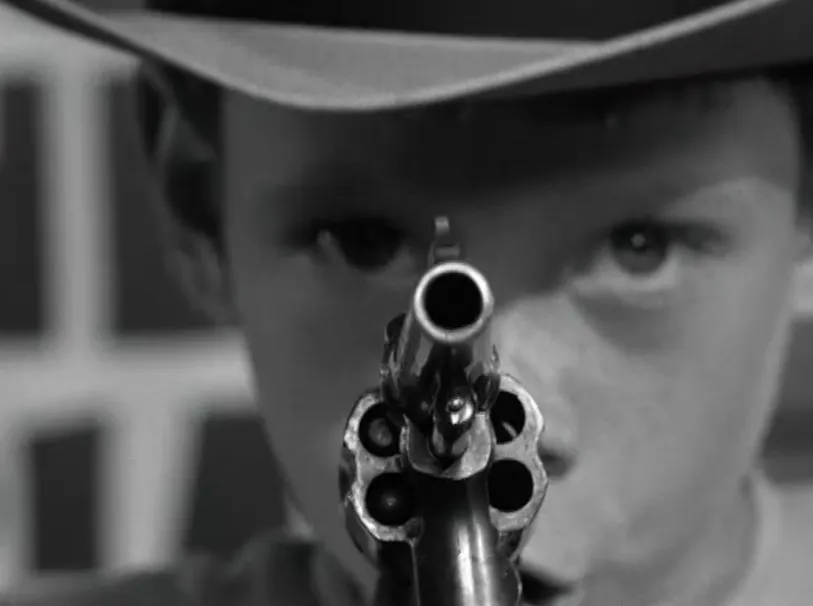
By this point Jackie continues to add more and more bullets until the chamber is completely filled, while strangers unknowingly talk him down from play-firing at them. Jackie's mother arrives at the supermarket and every time she attempts to get people's attention they're either ignoring her, interrupting her, or a coincidental occurrence keeps her from telling someone. Even when she finally gets the intercom microphone to call for Jackie, his name is censored by a churning coffee grinder.
Jackie leaves the supermarket, and when his entire family arrives in the parking lot, they hear what sounds like several rounds being fired off only to be reassured that it's the tailpipe hiccup from a car.
When I was watching these scenes unfold, I knew that because of the UI of the video player that I wasn't too close to the end of the episode, but despite that I was cringing and recoiling every time Jackie slowly pulled the trigger at someone, or quickly let off 2 or 3 shots in random spurts. This episode is 100% the epitome of Hitchcock's 'Bomb Under the Table' analogy when establishing the distinction between surprise and suspense in storytelling.
Finally, Jackie returns home with his revolver fully loaded and antagonizes Cleo, the black maid of the household, with begging to play. Cleo relents from all the insistence and says sarcastically "Okay, you go ahead and shoot me. It's alright with me. I made my peace to the Almighty. Go on, blaze away." A POV shot of Jackie aiming and following Cleo as she walks amps up the tension before he finally fires a live round.
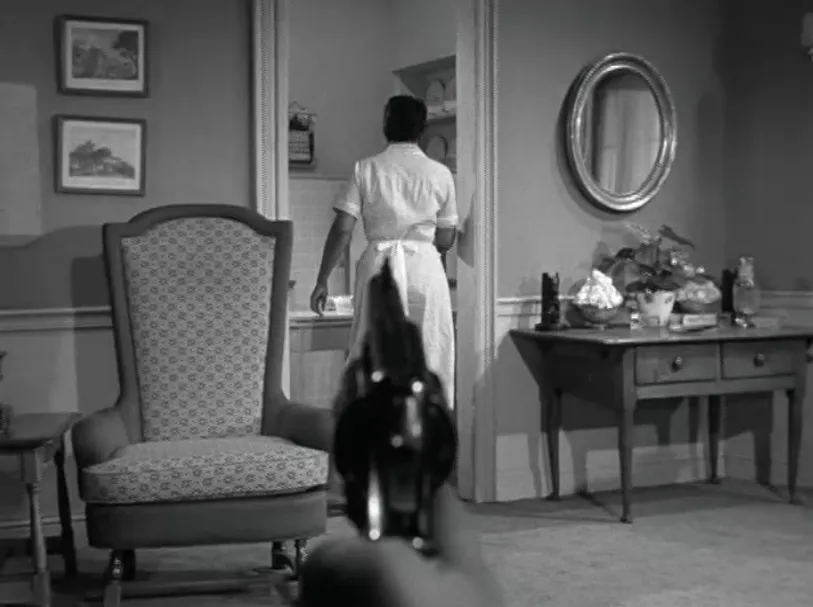
Luckily, Jackie's parents arrive, and with a throw of the African mask, the shot is diverted into the nearby mirror. Jackie runs to his mother for comfort and the last shot closes on Jackie's father and Uncle Rick holding the revolver and the mask.
To close out the episode, Hitchcock himself speaks to the audience, lecturing them about gun safety and says "Accidents of this type occur far too frequently nowadays and the tragic fact is with proper precaution they could be avoided.".
FINAL THOUGHTS
At face value, Bang! You're Dead seems like a simple story about being mindful of your personal firearms so that children don't accidentally harm anyone, but I feel that there's a lot more going on than meets the eye.
You could argue that Uncle Rick's return from Africa, his mentioning of paranoia from keeping his gun under his pillow, and the African mask are all to setup a plausible circumstance for Rick to have his gun but I think otherwise. I'll mention before I go off that whether or not Hitchcock intended all of these concepts as symbolism or whether it emerges from the historical context of when the episode was aired I find it valuable to analyze media to uncover meaning; intentional or not. This is merely my interpretation of the media and it goes without saying that it could all be coincidental.
The stories Uncle Rick tells about his time in Africa involving the history of the mask initially reinforces a stereotypical image of Africa as a place of violence and 'primitive' nature. These assumptions were fairly common in the 60's as depicted in the Western popular culture of the period that often aired on television at the time (Gunsmoke, Bonanza, and The Lone Ranger). Ironically though, the episode inverts that expectation.
The real danger and violence came from within an American's suitcase and the romanticism of Western media, cowboy games and toy guns. Jackie's casual relationship with pretend violence came not from the history of African tribalism, but from the colonial fantasy re-framed in Western media.
When Jackie is offered the mask as an object of interest, that is something of an exotic and artistic nature, he is indifferent to it and is more fascinated by a revolver. Jackie symbolically rejects culture, history and art in favor of a weapon. You could even argue that Jackie only feels this way because of what American society has taught him to value. Jackie is too young to distinguish the difference between the stories adults tell like Uncle Rick's experience in Africa and the mythology of violence depicted in television Westerns. Both are stories in which guns solve problems. When Jackie takes Uncle Rick's .38, the culture surrounding the gun has already prepared Jackie to use it.
The climax of the episode solidifies this take, as Jackie's father throws the African mask to interrupt Jackie's shot towards Cleo, which could symbolically imply that an object associated with the supposedly 'savage world' of Africa prevented an act of violence from the supposedly 'civilized world' of America.
On top of that, the shattered mirror could be interpreted as the reflection of American life being broken, where instead of the assumption that violence is an external force from Africa and other non-white continents, that it really comes from within their own American culture; nurtured by the biased fantasy media they consume.
Games like Cowboys and Indians/Cops and Robbers are nowadays thought of in antiquity; an idealized time where children played in the streets devoid of supervision and were inspired by television heroes such as Richard Boone's Paladin and James Arness's Marshall Matt Dillon. Both defenders of a 'Lawful' world of traditional family structures and humble hardwork.
When reframing history from a lens of good vs. evil, it's easy to indoctrinate the youth with the understanding of "shooting first and ask questions later".
Thanks for reading! -Dylan