5.24e Homebrew: Design Goals and Musings
So recently I've been experiencing a strange sensation to want to play 5e. This is extremely out of the ordinary as I'm typically an adamant OSR enjoyer, but it may be mostly in part of knowing if I work on a 5e project I will 100% get players onboard.
Playing 5e might be the perfect middle ground for me on systems when it comes to free-flowing ad-hoc systems and solidified rules + character builds. 5e's compact system of d20 + stat + proficiency (if relevant) vs. DC makes for easy improvised rulings for even the most strange player requests and if you feel extra smart you can give proficiency bonuses to Skills that don't fall under the same Ability Score (Intimidation with Strength mod).
Combat is really not that bad either as long as you have low enemy counts and can execute their game-plans quickly. I don't mind long combat rounds as long as the majority of the time is focused on the players making decisions. I believe the GM side of combat should be quick, tidy and focused on realism. Combats won't last nearly as long if they make Morale checks or parley with the party to avoid combat entirely.
With these things in mind, 5e is totally usable as an OSR system as long as the players understand the social contract that comes with OSR type games vs. neo-trad games. You can ignore the urges to roll skill checks for everything and let them do stuff as long as it makes sense for them to do it without issue. You may even ask what their ability score is and decide from there if it happens automatically or not. For a really good example, check out the Holmes Zenopus Dungeon, Room H.
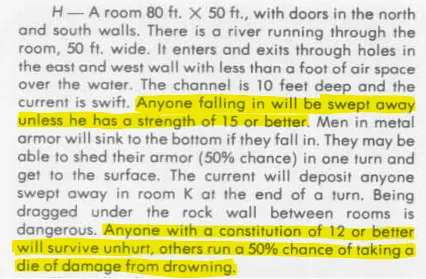
Stuff like this is really cool, and it shows they wanted Ability Scores to affect the game in other ways than just determining your languages and to-hit. It shows up several times more in other adventures such as S3 Expedition to the Barrier Peaks with +5% (per point of Dex above 6) or −10% chances based on Dex to climb into tubes or carefully remove electronic cards (Pg. 4 / Pg. 6) and WG4 The Forgotten Temple of Tharizdun to avoid a net trap by rolling under Dex with 4d6 (Pg. 11). So GET CREATIVE! Maybe their high ability score reduces the DC or maybe there's no check at all for a very nimble 17 Dex guy to jump or climb.
Criticisms of Modern D&D
It's mostly anecdotal evidence that I have for these things, from both being a player in these types of games and having watched popular Youtube channels; GMs cut rules of attrition, inconvenience and bookkeeping as they don't serve the game they want to play. When I was new to the hobby and had fresh eyes on the average 5e campaign experience, it felt that the GM was more like a Director for a film or TV series and the characters were the primary cast.
Anyone who's watched anime like Inuyasha, Cowboy Bebop or Dragonball Z knows that the narrative thrives on the progression of the primary cast and their Monster of the Week battles as more increasingly difficult threats approach on the horizon. Some anime even focus on particular characters with seasons or arcs made specifically for them. Many of my games played like this. The spotlight would jump between particular players as the campaign went on and that spotlit character became the cause for adventure. "My sister was kidnapped by the BBEG", or "I want revenge on the necromancer who destroyed my village", or "I wish to become the strongest, and must take down the current strongest to get there".
These types of games show up most often in the new wave of TTRPGS (1990s-now). Narrative focused games like Vampire: The Masquerade from The World of Darkness and Cyberpunk became the massive and developed the new era of Storyteller type GMs. There was a bit of history when players of these games looked upon D&D with prejudice, but if we look at the entirety of TTRPG history that's just not true. Many groups played TSR era D&D with narrative focus and role play.
When I've brought up the idea of playing 5e in a similar style to the TSR era, I get met with criticism of the game being more Arcade style, or Rogue-like. Characters are disposable, unremarkable, dirt farmers that walk single file into dungeons, like lemmings, ready to die. A stigma of old guard GMs being ruthless developed vs. a modern idealized kid-gloved GM who's more a caterer or entertainer than referee. Planning and incorporating player character stories and campaign narratives burned me out incredibly fast and I have no desire to run a game like that. Among modern D&D-ers there's a pervasive lack of interest for the 'Olde'. No interest in Swords and Wizardry, Shadowdark or Dungeon Crawl Classics. Less options, less choices, and less rules.
Rant Over, What Am I Gonna Do About It
To reel it all back in (I did a tangent) there's been a lot of design philosophy from AD&D and prior that I feel has been lost in 5e. A lot of these rules and options are still available to use, but for the typical game being run nowadays they get ignored or omitted. Some of the more common ones are tracking item weight/encumbrance, tracking items consumed like rations or arrows, and downtime to study spells or hone skills.
I want to reintroduce these olde traditions in an attempt to redeem 5e as usable for Olde Guard GMs and TSR fans. AD&D and OD&D both suffered from incomplete or incomprehensible rules that needed to either be fixed or nixed and being reluctant to make similar changes for the newer game sets a bias. Without additional supplements besides the corebooks, there's a chassis in both 2014 and 2024 5e D&D that can support OSR play.
So to end these brief post, my current plan is as follows:
- Make / Steal some easy to use Encumbrance rules
- Give Cantrips a resource management system, so they're finite + how this affects the caster classes
- Introduce a Paladin Fighter subclass (Paladin being Law / Knight coded)
- Morale and Parley rules
- Maybe Quicker Combat and Initiative tips?