5.14e Homebrew: Fighter Ranger
It's the summer of '75. You've been playing D&D with your buds for about a year, and everyone at the local hobby shop keeps talking about these new fan zines. They also mention TSR's own publication, The Strategic Review.
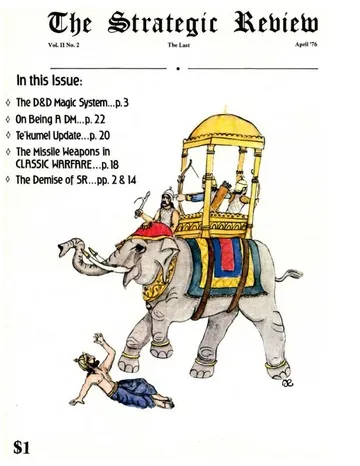
You finally pick up The Strategic Review, Volume 1, Number 2. As you flip through the pages, one article catches your eye: Joe Fischer's new Fighting-Man sub-class inspired by Aragorn; the Ranger.
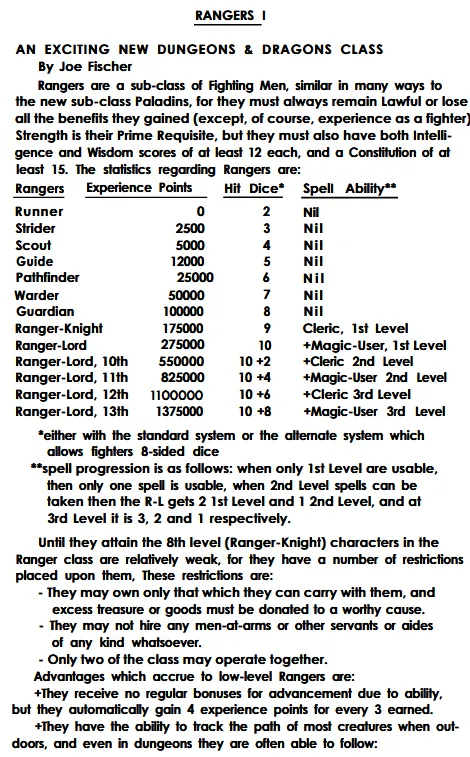
They excel at taking down Giant-type foes, have exceptional tracking abilities and are difficult to surprise. These advantages come at a price: higher ability score requirements, slower advancement, a Lawful alignment, and restrictions on accumulating wealth. Many of these traits are evocative of Aragorn and his character.
Another interesting note is that the Ranger class also got Spell-casting at 8th level. In the TSR magazine it was originally alternating levels of Magic User and Cleric spells, but by the time the Ranger was added in AD&D 1e they were changed to Druid spells.
Looking back at Joe Fischer's original design, it's striking how different the Ranger once was. Rather than a wilderness Spell-caster with a permanent animal companion, it was essentially a specialized Fighting-Man built around tracking, endurance, and hunting dangerous prey.
With all these facts in mind, I would like to create a Fighter sub-class for 5e that's heavily inspired from this pre-WOTC era Ranger. They won't start with access to magic early, nor will they begin with an animal companion, as many players now expect from the modern Ranger. Interestingly, Rangers weren't particularly associated with dual-wielding or animal companions until Drizzt became one of fantasy's most recognizable heroes. My own theory is that the dual-wielding connection can be traced back to the Drow entry in the Fiend Folio, which notes:
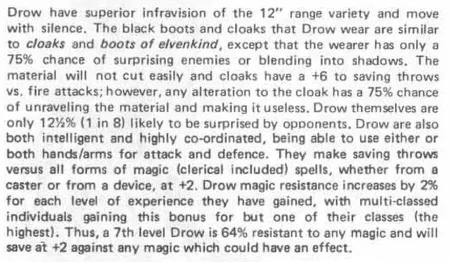
"Drow are also both intelligent and highly co-ordinated, being able to use either or both hands/arms for attack and defence." Pg. 34.
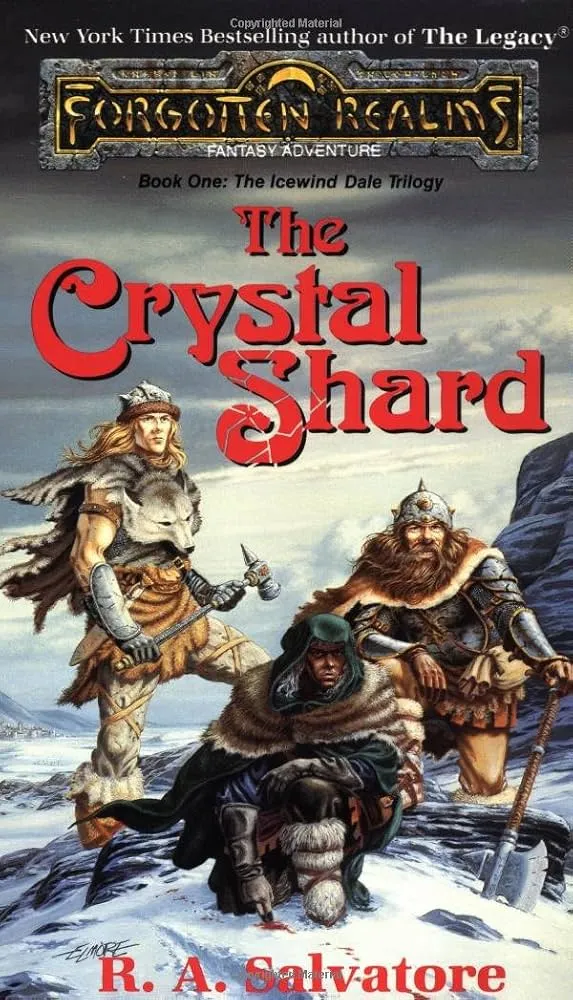
In the 1988 fantasy novel "The Crystal Shard" by R. A. Salvatore, Drizzt's magical panther Guenhwyvar makes their first appearance. Guenhwyvar comes from Drizzt's Onyx Figurine of Wonderous Power as a summon from the Astral Plane.

You could argue that, by this point in fantasy media, there was almost nothing more badass than a warrior fighting alongside a beast. It's easy to imagine that R. A. Salvatore wanted to give Drizzt a companion for exactly that reason.
The most obvious inspirations are The Beastmaster (1982), in which Dar the Barbarian fights alongside several animal companions, most notably Ruh the black tiger; Robert E. Howard's 1935 Conan story Beyond the Black River, where Conan is accompanied by a wild dog named Slasher; and Heavy Metal (1981), in which Taarna, the last Taarakian, rides into battle atop her giant bird-like mount, Avis.

Sadly, the Ranger sub-class below will not feature an animal companion via the abilities and features they get through advancement. This doesn't mean your GM won't give you the opportunity to find or tame one yourself! Also- like my last post featuring the Roguish Fighter, it's intended that you remove the Ranger class from the selection for your players if you plan on using this Ranger sub-class. It's an attempt to bridge the gap between the classic TSR Ranger and its modern incarnation.
With all of the ramblings out of the way - I present to you: The Ranger!
Ranger
3rd: Borderlander
You gain proficiency in two skills of your choice: Animal Handling, Investigation, Perception, Survival, and Nature. If you're already proficient, gain Expertise.
Choose 2 Terrain from the following: Forest, Plains, Swamp, Desert, Tundra and Mountains
You ignore difficult terrain and cannot become lost in your chosen terrain. When you forage in these environments, treat any roll of a 9 or lower as a 10.
3rd: Ranger's Focus
Rangers gain a number of Focus die depending on their level
- 3rd-4th: 4d6
- 5th-7th: 4d8
- 8th-10th: 4d10
These Focus die can be spent to use a number of abilities and features listed below. You learn 3 techniques at 3rd level, +2 at 7th, and +2 at 10th.
Camouflage: When attempting a Stealth check, you may add your Focus die result to the roll (declare before dice roll).
Deadly Shot: On a successful attack roll, add your Focus die result to your weapon's damage.
Exploit Weakness: When you attack a target that you've previously trailed, tracked or identified with a Survival or Nature check you may add your Focus die result to the damage. You also gain advantage on your attack against the same target on the next Turn.
Hamstring: On a successful attack roll, reduce the movement speed of the target to 10' until the start of your next Turn.
Keen Eye: When attempting a Survival/Perception/Investigation check, you may add your Focus die result to the roll (declare before dice roll).
Precision Shot: When attempting an attack on a target, you may add your Focus die result to the Attack Roll (can be used if Attack fails).
Sure Footing: When attempting a Athletics, Acrobatics, or Dexterity Save, you may add your Focus die result to the roll (declare before dice roll).
3rd: Foe Slayer
Choose a creature type: Beast, Giant, Monstrosity, Humanoid or Undead.
Once per turn when you hit one of these creatures deal extra damage equal to your Proficiency Bonus.
You and your party cannot be surprised by the chosen creature type.
Whenever you finish a Long Rest you may change this choice.
5th: Trailblazer
While you aren't wearing heavy armor: you gain 10' of walking speed, a climbing speed and swimming speed equal to your walking speed, and you ignore non-magical difficult terrain.
7th: Tireless Tracker
On a Short Rest you can gain Temporary Hit Points equal to 1d8 + your Wisdom modifier. You can do this a number of times equal to your Wisdom modifier per Long Rest.
You ignore the first level of exhaustion while traveling and regain this ability on a Long Rest.
You also have advantage against Constitution saves vs. Forced Marches, extreme climates, and similar environmental hazards.
10th: Call of the Wild
You gain a number of Cantrips equal to your Proficiency Bonus +2 and 1st level spell slots equal to your Proficiency Bonus that you can use to prepare any 1st level spells from the Ranger spell list.
These spells use your Wisdom modifier to determine Spell Attack/Spell Save DC.
You also gain the Hunter's Mark spell as an ability to be used at will. When used, Hunter's Mark is cast as if it were the 4th level version of the spell (tracking targets for 8 hours).
You also may choose one of the following features:
Giant Slayer: Once per turn when you hit a creature with a weapon, the weapon deals 1d8 additional damage if the target is missing any hit points.
Horde Slayer: Once on each of your turns when you make an attack with a weapon, you can make another attack with the same weapon against a different creature that is within 5 feet of the original target, that is within the weapon's range, and that you haven't attacked this turn.
14th: Vanish
You may use your bonus action to hide. You cannot be tracked by non-magical means.
18th: Focus Mastery
You gain additional Focus Die equal to your Wisdom modifier per day.
Whenever you roll initiative, regain one expended Focus Die.
When using Hunter's Mark, the ability is cast as if it were a 5th level spell slot or higher (24hrs of tracking).
20th: Expert Slayer
You may add your Wisdom modifier to either the attack or damage roll vs. your chosen Foes.
You also gain the ability to cast 2nd level Ranger spells equal to your Proficiency Bonus minus 3.